Best Composting Toilets Review: Waterless Throne Comparisons & Smell Ratings
Contents
- Best Composting Toilet Reviews
- 1. Nature’s Head Dry Composting Toilet
- 2. Separett Villa 9200
- 3. Nature’s Head Self-Contained Composting Toilet with Spider Handle
- 4. Sun-Mar Excel Self-Contained Composting Toilet
- Conclusion
- What to Consider When Buying Your Composting Toilet
- Local Laws
- Space
- Capacity & Maintenance
- Electricity
- Buyers Also Asked
- Why Use a Composting Toilet?
- How Do Composting Toilets Work?
- Do Composting Toilets Smell Bad?
- What’s Next?
- Sources
 When nature calls, the composting toilet answers! Eco-friendly and functional, these toilets turn human waste into usable, hygienic fertilizer.
We compared the most popular self-contained composting toilets on build, ease of use, maintenance and odor control to narrow the field to a few strong picks.
Our top choices are easy to use, well constructed, and value-conscious to get the best deal for the money. Most of all, we looked for models that stay hygienic and help you avoid horror stories about foul odors when they are set up and maintained correctly.
We’ve separated the paydirt from the stinkers! You can find the best composting toilet to meet your needs in our reviews below.
Here are our favorite composting toilets on the market right now…
| Product | Details | ||
|---|---|---|---|
| 1. Nature’s Head Dry Composting Toilet with Standard Handle | 1. Nature’s Head Dry Composting Toilet with Standard Handle Best Overall | Overall Best Value - Self-Contained - Urine Diverting - Easy Installation | Check Price |
| 2. Separett Villa 9200 | 2. Separett Villa 9200 | Lowest Profile - Waterless - Urine Diverting | Check Price |
| 3. Nature’s Head Self-Contained Composting Toilet with Spider Handle | 3. Nature’s Head Self-Contained Composting Toilet with Spider Handle | The Original - Compact - Great Ventilation - Made in USA | Check Price |
| 4. Sun-Mar Excel Self-Contained Composting Toilet | 4. Sun-Mar Excel Self-Contained Composting Toilet | Most Expensive - Waterless - Odorless - NSF Certified | Check Price |
Best Composting Toilet Reviews
1. Nature’s Head Dry Composting Toilet
Click for Price
The Nature’s Head is built very well, feels sturdy and works very reliably.
In our opinion, the Nature’s Head Dry Composting Toilet is the best composting toilet for the average buyer.
As far as we’re concerned, they met their goal with smashing success! The Nature’s Head is built very well, feels sturdy and works very reliably. We also appreciate that this toilet was more affordable than most of the composting competition. Best of all, it’s easier to install and to use than other composting toilets.
In short, the Nature’s Head is a self-contained composting toilet system, practical not only for boats but any place where space, plumbing, and electricity is inconvenient or absent. We suggest it for absolutely any application!
We think it offers one of the best self-contained composting toilet experiences you can easily buy. Short of custom-building your own setup or special-ordering a Separett, it’s hard to beat.
The Nature’s Head is popular on boats, in RVs and in tiny homes, and the company markets it for exactly that kind of off-grid, space-limited use.
Pros:
One of the best aspects of the Nature’s Head system is how little it smells when used correctly. The urine bottle and solids tank are separate, and a small fan vents the solids chamber outside.
We’re also quite pleased with the construction of the toilet unit, which is simultaneously lightweight and durable. It should last for years of composting! It’s designed to take up very little space, too!
One of the coolest features of this Nature’s Head model is the dry composting system. Note that it needs power for its built-in 12-volt vent fan, which draws very little current and can run from a battery or solar setup. This toilet separates liquid waste and solid waste into different containers. The absence of water in the compost reduces the danger of leaks and odor escaping, while also keeping moisture levels inside the composting chamber ideal for hygienic decomposition.
The separation is a great idea, since the solids tank stays drier and smells far less than a mixed waste tank. The urine bottle needs emptying often, while the solids tank lasts roughly 60 to 80 uses, or about a month for two people, according to the manufacturer.
The Nature’s Head is built very well, feels sturdy and works very reliably.
Another strong point of the Nature’s Head is value. It usually costs less than many premium composting toilets, and we think it works at least as well.
Cons:
We have few complaints about this model. Most owner feedback is positive, and the complaints we found were mostly about small design details.
For instance, one tall user (6 feet 1 inch) found the toilet uncomfortable to use. Another wished that the solid waste could be pulled out with a drawer. Instead, the design forces owners lift up the whole unit to remove the compost. That does require a bit of upper body strength, and an injury-free back. However, none of these problems were deal-breakers for the buyers whose reviews we read.
2. Separett Villa 9200
Click for Price
It’s functionally similar to the Nature’s Head, and there’s no real difference in quality.
Separett is a Swedish company that is well known in Europe and has been gaining recognition in the United States. Similar to the Nature’s Head, the Separett features a waterless system that brings convenience to remote homes.
The Separett may come with a higher bottom line than the Nature’s Head, but its attractive design and inoffensive maintenance will certainly be worth the extra cost to many buyers. It’s functionally similar to the Nature’s Head, and there’s no real difference in composting quality. The difference is the way you deal with liquid waste, and the way the composting toilet looks in the home. Your decision will probably be based more on aesthetics than functionality, as well as your preference for disposing of liquid waste.
Note: as of this writing, the Separett toilet is unavailable through Amazon and other common retailers, and doesn’t appear to be coming back anytime soon. That’s because the company has a fairly exclusive dealer network, in addition to the fact that this is a pretty niche market to begin with. You can purchase their products from their website, or contact the company for local toilet dealers. We think it’s worth the extra hassle to get, though, because it’s a great model if people are looking for a well-designed, non-dry system.
Pros:
What distinguishes this model from the composting toilet competition is its sleek design and small size–ideal for those people looking for a lower-profile model of composting toilet. You’ll notice that it’s a lot sleeker than either variation of the Nature’s Head toilet!
If you’ll be installing your toilet near an outer wall, and don’t need to worry about freezing, it’s a very nifty solution.
The biggest functional difference is the way the Separett toilet deals with liquid waste. The urine diversion system differs slightly from the Nature’s Head. Instead of running into a container, urine is simply piped outdoors. Solid waste is contained like the other toilets on the market.
Separett recommends a small drain pit for your liquid waste, but it can also be diverted into a container. If you’ll be installing your toilet near an outer wall, and don’t need to worry about freezing, it’s a very nifty solution.
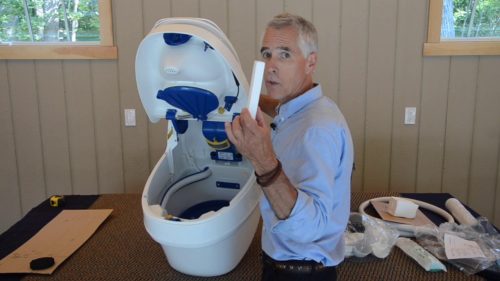
It’s easy on the eyes inside and out–the interior of the composting toilet has a weight-activated trap door that obscures any waste from view. When someone sits on the seat, the airtight trapdoor swings open. and swings shut again when the user stands. It’s a great feature, particularly for those with delicate sensibilities.
Another benefit for the squeamish: the composting process takes place in a removable bin lined with a compostable bag. Simply remove the bin when it gets full, and let the composting process take place outdoors–instead of inside the toilet.
Like the Nature’s Head, the Separett toilet is well-built and compact enough to transport to homesteads and vacation cabins without much hassle. Check the current spec sheet for its exact weight. Previous buyers said it was a great seasonal toilet option for camps and cabins that don’t have reliable or permanent septic hookups. They also found it very easy to install, thanks to the manageable size and weight.
Cons:
As with the Nature’s Head, we have few complaints about this one. Choosing between them is mostly a matter of deciding how you want to handle liquid waste.
The main reason it came in second place on our list is its price tag. At the time of writing it’s pricier than the Nature’s Head toilet, without offering too much more in the way of practicality.
It’s also worth considering that you’ll have a slightly harder time getting hold of one of these than you would if you were to buy a Nature’s Head.
3. Nature’s Head Self-Contained Composting Toilet with Spider Handle
Click for Price
This one has a modified design that works a bit better in tight spaces.
Does this Nature’s Head toilet unit look familiar? If it does, well spotted! We’ve recommended the same composting toilet twice in this guide–albeit with a few tweaks! The Nature’s Head model we recommended above is the company’s standard toilet model, which is also their best-selling composter. This one has a modified spider handle design that works a bit better in tight spaces.
Pros:
It has the same innovative ventilation system, fan, and modular disposal system as the other Nature’s Head. The only significant difference is the spider handle. Unlike the standard model, this one has a compact spider crank handle like you’d see on a lot of marine applications. The spider handle makes a big difference in spaces where every inch counts!
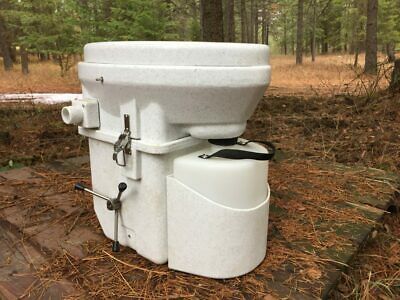
Previous buyers said this toilet was the perfect fit for their small spaces, on land and on water! While you could probably get the other Nature’s Head toilet to work anywhere, this spider handle one requires less clearance, and simply feels better to use in tight spaces.
Since it’s a modular design with simple connections, it’s extremely easy to service.
Like the other Nature’s Head, this spider handle toilet is made in the USA. Reviewers often praise the sturdy build quality of the molded plastic body and fittings.
It’s totally self-contained and separated like the other Nature’s Head. You’ll have urine collection bottles and an isolated dry composting compartment.
Since it’s a modular design with simple connections, it’s extremely easy to service. Reviewers said that as long as you’ve got a screwdriver handy, you can make whatever modifications or repairs you need to without trouble.
As with the standard model, the spider handle version is covered by a 5-year warranty.
It also has the same low price as the standard model!
Cons:
Some buyers reported having some issues with the side latches, but they said that replacements were easy to obtain through the warranty process.
*****We’re aware that it might seem odd to recommend two Nature’s Head models with only minor differences. There are other brands in the industry, after all, and some of them make very popular composting toilets. However, we’ve seen a big drop-off in quality between our current recommendations and the other options on the market.
For instance, we used to recommend the Sun Mar as one of our top composting picks. It’s the original throne of this kind, and it still has some strong buyer loyalty. The more we’ve looked at it these days, though, the more it seems like it just isn’t up to scratch.
Take a look for yourself, and see what we mean!
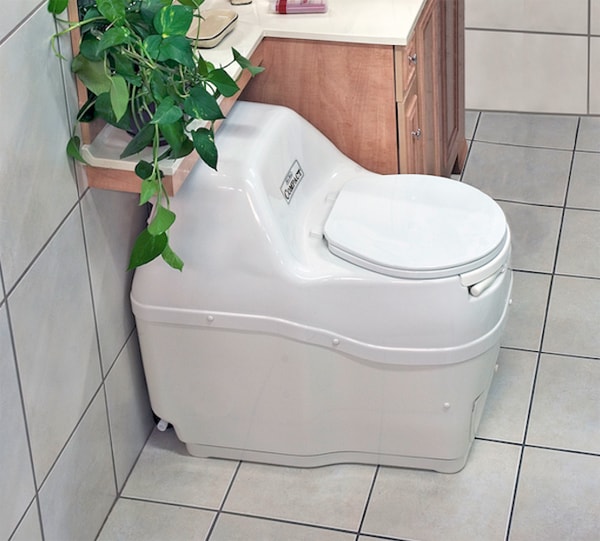
4. Sun-Mar Excel Self-Contained Composting Toilet
Click for Price
This signature model is one of the most popular composting models ever to hit the market.
Sun Mar is one of the most recognizable brands in the small but growing world of composting toilets, and it has been making them for decades. Sun-Mar says its Excel was the first self-contained composting toilet certified by NSF. Some people still swear by it!
We used to include the Sun Mar in our Top Three, but it’s recently slipped out of our rankings. Here’s why:
Of all the toilets listed here, Sun Mar’s model is the largest. The main body is about 31.5 inches high, so it uses a detachable footrest that brings the effective seat height to about 17 inches. It’s certainly less portable than the other two models. That being said, the size does give it high capacity. Sun-Mar rates it for 3 adults or a family of 5 in residential use, which used to make it a model worth considering for larger families and long-term users. However, given the user-friendliness of more recent composting models, we think it now seems bulky and unnecessary.
Pros:
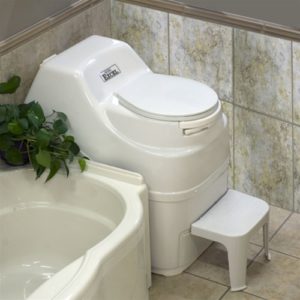
With some happy owners asserting they’ve used the Sun Mar Excel for over a decade, there’s no doubt these composting toilets stand the test of time when maintained properly. Previous buyers said their units were still going strong after more than a decade of regular use. That’s especially impressive given that many reviewers had installed their Excel’s in harsh environments, up in the mountains or in backwoods cabins.
Its rotating Bio-drum sets it apart from the other models here.
Its rotating Bio-drum, which you turn with a crank to mix and aerate the compost, sets it apart from the other models here. That makes it an excellent choice for people who process lots of compost for a garden since it keeps everything going steadily. Again, the Sun Mar has a higher capacity than the other two toilets we reviewed.
Cons:
For most buyers, the Sun Mar Excel doesn’t seem worth the extra money. Owner reviews are more mixed than for our top picks, and some owners report real trouble with it. It was certainly great when it was the only game in town, but now other companies are doing it better.
There were many complaints about the plastic crank that is used to tumble the compost drum. While previous buyers said the company shipped out replacements at no cost and with no hassle, frustrated customers eventually ditched the company handle and installed a metal aftermarket handle to solve the problem once and for all. It’s one of those design issues which later models from other companies have solved.
Some users also complained quite a bit about the smell. While others insisted that proper use should leave the unit odorless, the high number of complaints indicate that the Sun Mar Excel isn’t nearly as user-friendly as the other models–with grim results for people who fall outside the learning curve.
Cleaning was also reported as unhygienic, and there were a number of complaints about mold and bugs. Previous buyers said that because the contained toilet design was a breeding ground for black flies and mold mites, cleaning the unit was an unsanitary struggle which was best avoided. People said that while the situation was manageable if users knew precisely how to use the unit, it could get out of control if the SunMar was left sitting for several days in a row. If you want you can use a shower cleaner as an alternative.
Conclusion
- Nature’s Head Dry Composting Toilet (Standard Model)
- Separett Villa 9200 (Lightweight)
- Nature’s Head Self-Contained Composting Toilet with Spider Handle (Spider Crank Handle Model)
- Sun Mar Excel (Previously Recommended)
Which of the models featured in this buying guide should you buy?
-
- Nature’s Head (standard)
- Nature’s Head (spider crank)
- Separett
*At a higher price than our top pick, and with more user complaints, there’s little incentive to purchase the Sun Mar Excel over the Nature’s Head or Separett. Sun Mar may be the original self-contained composting toilet, but this “throne” has been usurped.
Most buyers will want to choose between one of the Nature’s Head toilet models and a Separett.
We think the Separettis the best composting toilet, but it’s not as convenient to buy or affordable to purchase as a Nature’s Head. If you can pony up the extra cash, and are going to make lots of use of your composting toilet, go for the Separett.
If you want the convenience of being able to buy a composting throne on Amazon, and the savings, you won’t be missing out on much by going with a Nature’s Head. Both versions of this setup are user-friendly, effective, and reliable. We think they’re better choices for the average buyer, if not the absolute best.
The upside of all the interest in composting toilets these days is that the choices are getting better and better! Anyone of these three toilets will serve people well.
If you’re choosing the best composting toilet for your needs, we would suggest you try the Nature’s Head model for its incredible value for money.
What to Consider When Buying Your Composting Toilet
Local Laws
Before purchasing anything, you should review the local laws governing waste disposal at your location. Unfortunately, composting toilets are relatively new and unknown. Certain states and municipalities haven’t updated their laws to account for hygienically-treated human waste. You might be fined in these locations for using your compost toilet.
So, double-check with a local authority before you start to use one. Generally, anyone in a rural area with plenty of their own land won’t need to worry. They’re made for rural spots and cabins anyway. However, you can imagine that most urban and suburban areas aren’t going to be especially enthusiastic about a neighbor composting poo in the back yard.
Certain states and municipalities haven’t updated their laws to account for hygienically-treated human waste.
Space
These are pretty big things to install. They have a much bigger footprint than your average throne, even if they don’t require any piping. For homes on the move–like tiny houses, RVs and trailers–space is a precious resource. Make sure to review the dimensions of your prospective toilet, and compare them to your available space.
They have a much bigger footprint than your average throne, even if they don’t require any piping.
Capacity & Maintenance
Your own attitude towards maintaining your composting toilet and the byproduct should weigh in. Some composting toilets are user-friendly, while others require users to carefully study the manual to avoid worst-case scenarios.
Some toilets will need to be emptied more often than others. Consider the number of people who will use the toilet, and how long they will be using it. Figure out which approach is the best for your lifestyle and personal preferences.
Some toilets will need to be emptied more often than others.
Electricity
Unlike a traditional indoor fixture, composting toilets usually need some power, mostly for a vent fan or heater. Power needs vary by model, so check them against your location. Several brands offer versions for users without steady grid power.
For example, the Separett Villa 9210 toilet can be used with a battery and/or solar power. The Nature’s Head fan runs on 12-volt DC, so it can run from a battery, power station or solar panel, and Sun-Mar sells a non-electric Excel NE model.
Power needs vary by model, so check them against your location.
Buyers Also Asked
Why Use a Composting Toilet?
Properly set-up compost toilets have a very low ecological footprint. As water usage concerns grow, it’s worth pointing out that toilets account for nearly 30 percent of an average home’s indoor water use, according to the EPA.
Replacing a flush toilet with a waterless composting one removes that use entirely, which can add up to thousands of gallons a year for a household. The EPA has an informative brochure on the environmental impact of composting toilets.
How Do Composting Toilets Work?
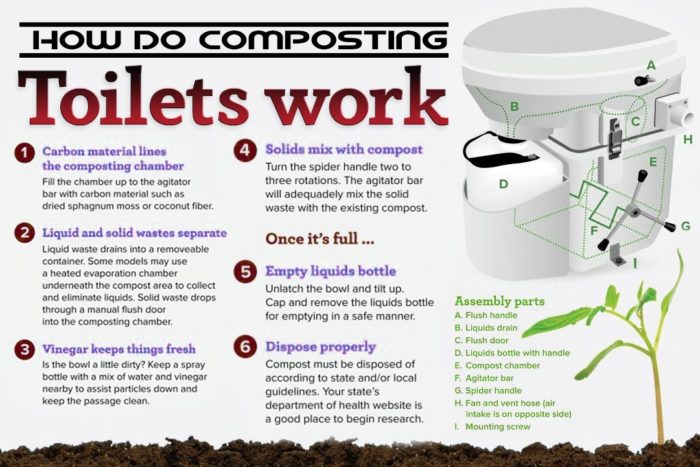
Composting toilets operate much like the composting system you’d use in home gardens. They help accelerate decomposition and leave you with a manageable, productive waste material. When the process works well, the final product is dry and earthy, but it is still treated human waste, not the same as a bagged garden fertilizer.
Depending on your state’s laws, it can usually be buried or used around non-edible plants. Don’t use it on food crops, and wear gloves when you handle it. If you’re an avid gardener, this is a great way to supplement your kitchen scraps with some extra fertilizer. We have a full guide to how composting toilets work here.
Do Composting Toilets Smell Bad?
When considering the switch from a traditional toilet, a central concern for many consumers is the threat of odor. The idea of a non-flushing toilet might conjure up memories of the horrid stink of a porta-potty or an old-school outhouse.
Those fears can be put to rest. Modern composting toilets that are set up and maintained correctly produce very little odor. They use vent fans, airflow and seals to carry smells outside. Composting toilets have proven so effective at eliminating odors, some higher-end models have replaced traditional toilets in eco-conscious suburban homes. Try installing afaucet for water purpose.
What’s Next?
Use our reviews and buying guide to pick the best composting toilet to meet your needs. You can also compare and contrast the best toilets on the market using our guides and lists.
Sources
- Nature’s Head Composting Toilets, Nature’s Head
- Excel, Sun-Mar Corporation
- Residential Toilets, US EPA WaterSense