How Does A Composting Toilet Work? Everything You Need To Know
Contents
- Composting Toilets – What’s the Lure?
- Parts of a Composting Toilet
- Storage Receptacle or Chamber
- Ventilation
- Leachate Mechanism
- Access Door
- How Decomposition Happens
- How Does a Composting Toilet Work?
- Factors that Affect the Length of Decomposition Time
- Number of People Using It
- The Capacity of the Toilet
- Design
- Conclusion
- Sources
Composting toilets are gaining in popularity. They’re no longer just an option for campers but also for people with a mobile lifestyle. Even regular homes can install a composting toilet, where local rules allow it.
Composting Toilets – What’s the Lure?
Traditional toilets already work, why then should people still consider composting toilets? Some people are attracted to them because they need no water or sewer connection, which can make installation simpler in remote spots.
Installing a septic system can be a major expense, depending on the soil, the setup and the location of your property. Composting toilets have a wide price range, from simple self-contained units to large central systems. Keep in mind that the EPA notes a home with a composting toilet will usually still need a way to handle graywater from sinks, showers and laundry, often a septic tank and drain field.
Its impact on the environment can also be lower than a traditional toilet’s. The finished material shouldn’t go on food gardens; the EPA says it legally must be buried or removed by a licensed septage hauler in line with state and local rules. Composting toilets also don’t use water to flush, while even water-efficient toilets use about 1.28 gallons per flush. That can add up to thousands of gallons a year for one household.
Installation is also more flexible. These composting toilets can be placed practically anywhere as they do not require in-house plumbing connection. This is why it is a great option for those who live in mobile homes or those who are living in remote areas. It doesn’t require water to be flushed down. You typically only need to add a carbon-rich bulking material, such as sawdust, peat moss or coconut coir, depending on the manufacturer’s instructions. Aerobic bacteria and fungi do the actual breaking down. The bulking material gives them carbon and keeps the pile loose so air can reach it.
Parts of a Composting Toilet
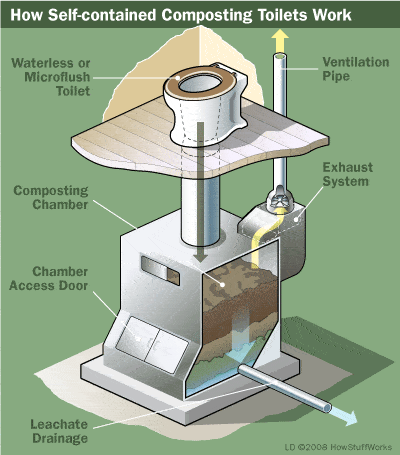
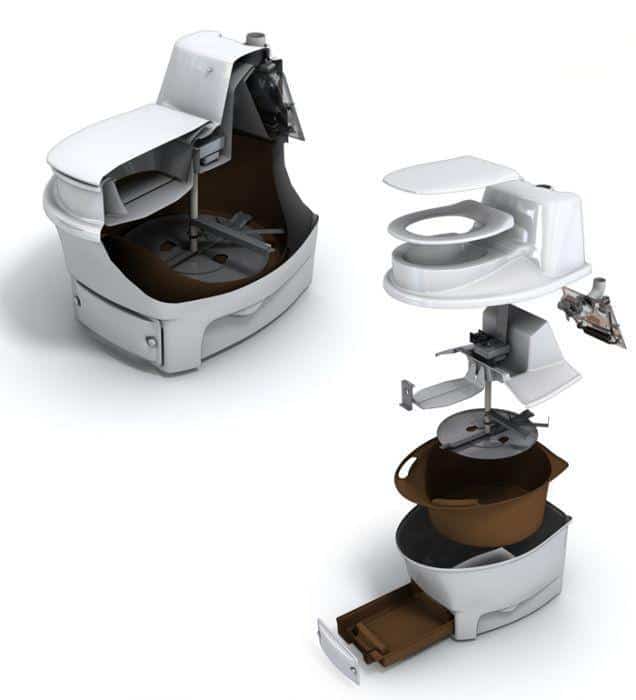
The toilet itself is composed of two parts: the part that you use for sitting and the part that is used for composting. The latter is composed of more parts such as the following:
Storage Receptacle or Chamber
Once the wastes are released from the body, they go straight into the composting chamber or receptacle. This is where they sit while they decompose. This is where the unique design of the composting toilet works. Many designs separate the solid waste from the liquids, using a sloped chamber, a drain or a separate urine container.
Ventilation
There is a unit that is in charge of eliminating gases. It also contributes to the degradation of the wastes in the chamber.
Leachate Mechanism
This mechanism helps get rid of the excess liquid that has gotten in the chamber. Excess liquid needs to be removed in order to allow bacterial activity to flourish.
Access Door
An access door allows users to get the decomposed material easily. Once the decomposition process is done, you can open the access door and get the contents.
How Decomposition Happens
Human waste is mostly water. Urine is almost all water, and feces are roughly three-quarters water. Some of that moisture evaporates, and the toilet’s vent system helps it evaporate faster. There are also some designs that allow external factors like the wind and the heat from the sun to evaporate the liquids in human waste. This is the case when it comes to passive composting latrine.
In the event that external factors can’t be relied on, there are electric systems that work in heating up the waste, thereby causing the excess moisture to evaporate.
However, for the composting process to happen, there should still be enough moisture in the wastes. The EPA says moisture should stay between about 40 and 70 percent, with 60 percent as the sweet spot. There has to be a good balance between heat, oxygen, moisture and aerobic bacteria. This is when the decomposition process happens. The wastes will then turn into humus, shrinking to about 10 to 30 percent of their original volume.
How Does a Composting Toilet Work?
Through the design of the composting toilet, the liquid waste is often separated from the solid ones. Depending on the model, urine drains to a collection tank, gets evaporated, or is diverted to a separate container you empty. This leftover liquid is called leachate.
The solid wastes, on the other hand also reach the composting chamber through gravity and undergoes the decomposition process explained earlier. In order to maintain good oxygen levels, aerating the compost is essential. This can be done with the help of a manual agitator. In some cases, composting toilets come with a rotating chamber. The chamber can be rotated in order to oxygenate its contents.
Factors that Affect the Length of Decomposition Time
So how long does the decomposition process work? There is no exact answer and this can depend on a number of factors such as the following:
Number of People Using It
The more people using the toilet, the more waste it has to process, and the faster it fills. It might also require adjusting the four elements of decomposition, especially adding more bulking material and mixing more often. Otherwise, the pile can turn anaerobic. You can tell there is not enough balance in the 4 elements if the toilet starts to smell bad.
The Capacity of the Toilet
Composting toilets are not created equally. Some are designed to handle more wastes and others might not work quite as well when exposed to large volumes of wastes.
Design
Some toilets are designed for long-term decomposition. These toilets are better for people who don’t like to constantly monitor the condition of their toilet. These are also better for residential properties and mobile homes. However, for camping activities, you are better off with a short-term decomposition toilet.
In general, it takes months for material in a composting toilet to break down, and longer for it to finish curing. The EPA notes that home units usually don’t get hot enough to kill pathogens quickly, so time is what makes the end product safer. Follow the manufacturer’s schedule and your local rules for emptying and disposal.
Conclusion
It’s important to know local regulations first when it comes to composting toilets. They’re not allowed everywhere, so make sure you check with your local health or building department before installing one. Look for a unit certified to NSF/ANSI Standard 41, the standard that covers composting toilets. Once you are ready to buy one, check out our reviews. We also have a detailed guide on how to buy composting toilets. Read this guide and our reviews to make a better buying decision.
Sources
- Water Efficiency Technology Fact Sheet: Composting Toilets, US EPA
- Residential Toilets, US EPA WaterSense